
SMS platforms for high-volume sending help organizations deliver messages at scale, but the reliability takes more than raw speed. The best platforms keep messages flowing during traffic spikes, protect deliverability, handle carrier compliance, and give you clear reporting on what was actually delivered.
High-volume sending also means different things to different teams. Some organizations need developer-first infrastructure for alerts, authentication, or transactional messaging. Others need a platform that can handle large sends while also powering subscriber growth, targeting, and two-way engagement. The right choice depends on your volume, workflow, technical resources, and the role SMS plays in your broader strategy.
The best SMS platforms for high-volume sending in 2026 are Subtext, Twilio, ClickSend, Messente, Bird (formerly Message Bird), Vonage, and TextUs.
What Should You Check for High-Volume SMS Reliability?
Confirm a vendor's throughput and burst capacity, carrier registration support (10DLC or short code), retry and fallback logic, and real-time delivery reporting. Ask for delivery SLAs and examples of peak-day performance, and verify how they handle carrier filtering and complaint mitigation. These checks show whether a platform will reliably deliver at scale.
High-Volume SMS Reliability Checklist
Use this checklist to evaluate any platform before you commit.
-
Throughput guarantees and burst capacity. Know how many messages per second the platform can sustain and how much extra volume it can absorb during a short spike.
-
Carrier registration (10DLC) support and management. Find out who files your registration, how long approval takes, and what happens if a campaign is rejected.
-
Retry and fallback logic for failed messages. Check whether failed messages are retried automatically, how many times, and what triggers a fallback route.
-
Delivery monitoring and SLA reporting. Look for real-time delivery status, carrier error codes, and uptime commitments in writing.
-
Queueing behavior during spikes. Ask whether messages queue and send in order, how long a large send takes to finish, and whether you can see queue status while it runs.
-
Support for dedicated short codes or toll-free messaging as needed. Make sure the platform offers the number types your volume and use case require.
Ask This of Every Vendor
Put these four questions to every platform on your shortlist, and ask for delivery reports or examples of peak-day performance to back up the answers.
-
What is your max sustained throughput and burst capacity?
-
How do you handle carrier filtering and complaint mitigation?
-
Do you provide delivery SLAs and real-time reporting?
-
How do you support registration and compliance (10DLC/short code)?
High-Volume SMS Platforms at a Glance
| Platform | Best for | Messaging Style | Main Tradeoff |
| Subtext | Publishers, brands, creators, and audience teams | High-volume broadcast plus two-way messaging | Less suited to pure developer-first transactional builds |
| Twilio | Developer-led teams that need API flexibility | Programmable, global messaging | Requires meaningful engineering ownership |
| ClickSend | Teams prioritizing simple bulk sending | Dashboard plus API bulk sending | Limited advanced engagement workflows |
| Messente | Multinational teams with mission-critical traffic | Delivery-focused, international | Few built-in marketing workflows |
| Bird | Brands running SMS inside an omnichannel strategy | Omnichannel messaging | More complexity than SMS-first buyers need |
| Vonage | Enterprise transactional, alert, and verification messaging | A2P transactional messaging | Less geared to non-technical teams |
| TextUs | Sales, recruiting, and customer-facing teams | Team-based conversations | Not built for infrastructure-heavy bulk sends |
1. Subtext
Best for: publishers, brands, creators, and audience teams that need reliable high-volume sending with hands-on compliance support, segmentation, and two-way engagement.
Subtext is built for teams that send at scale and want SMS to work as an audience channel, not just a one-way broadcast tool. It's a fit when reliable delivery and a direct audience relationship both matter.
At high volume, reliability depends on more than throughput. Registration, sender reputation, and message relevance all affect whether texts actually land, so those are the areas to evaluate.
Where Subtext Stands Out
Compliance handled for you
Subtext files 10DLC registration on your behalf, with no separate registration fee, and most programs are live in about two weeks. Built-in guardrails help keep campaigns within carrier rules after launch, which protects deliverability as volume grows. Subtext has been running SMS programs for publishers, brands, and creators since 2019.
Broadcast and two-way messaging in one platform
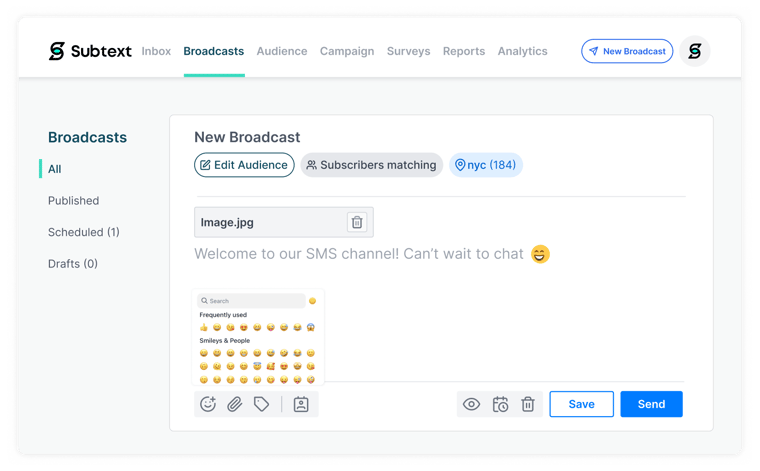
Subtext supports high-volume broadcasts alongside subscriber replies and conversations. Teams can send to a large list and manage the responses from the same inbox.
Targeting that keeps messages relevant
Audience tags, segments, and personalization let teams send smaller, more relevant messages instead of blasting the full list every time. Fewer irrelevant texts mean fewer opt-outs and complaints, which helps sender reputation. Subscriber data stays first-party, so the audience belongs to you.
Growth and integration tools
Keyword signups, QR codes, imports, and automation support list growth, while webhooks and API access connect Subtext to the rest of your stack.
-
Messaging style: High-volume broadcast plus two-way conversational messaging
-
Strengths: Managed 10DLC registration, segmentation, audience growth tools, first-party data ownership
-
Tradeoff: Less tailored to pure developer-first transactional builds than a CPaaS like Twilio
Key takeaway: Subtext is a strong choice for teams that need reliable high-volume sending and also want SMS to support engagement, retention, and long-term audience value.
2. Twilio
Best for: developer-led teams that need maximum API flexibility and global programmable messaging
Twilio is one of the most established names in business messaging infrastructure. It is best suits technical teams that want to build custom SMS workflows and manage messaging inside a broader product or communications stack.
Where Twilio Stands Out
Developer-first flexibility
Twilio gives engineering teams broad control over routing, automation, number management, and delivery logic.
Global reach
It works wel for organizations that need international messaging support in addition to U.S. sending.
Mature API ecosystem
Its documentation, SDKs, and developer tools make it a common choice for custom implementations.
Tradeoffs
-
Requires meaningful technical ownership
-
Costs can get more complex at higher volumes
-
Less natural fit for non-technical teams
Key takeaway: Twilio fits for organizations that want maximum flexibility and have the engineering resources to manage it.
3. ClickSend
Best for: teams prioritizing straightforward bulk sending and predictable pricing.
ClickSend appeals to teams that want bulk SMS without a heavy implementation process. It offers a simpler dashboard-plus-API setup for organizations sending at volume.
Where ClickSend Stands Out
Cost-conscious structure
ClickSend is attractive to teams that focus on keeping per-message costs manageable.
Simple setup
It is easier to get started with than more infrastructure-heavy platforms.
Broad sending coverage
It works well for general-purpose outbound messaging across a wide range of destinations.
Tradeoffs
-
Less robust for advanced engagement workflows
-
Fewer tools for audience ownership and relationship-building
-
Less hands-on strategic SMS support
Key takeaway: ClickSend fits for teams that want dependable bulk sending with a simpler setup.
4. Messente
Best for: multinational organizations prioritizing delivery quality and reliability for mission-critical traffic
Messente is better known for delivery quality and route optimization than for marketer-facing campaign features. It fits organizations where reliable delivery is the main priority.
Where Messente Stands Out
Delivery-focused infrastructure
Messente emphasizes route quality and consistency, especially for time-sensitive use cases.
International messaging
It is worth considering for organizations with global requirements or cross-border traffic.
Tradeoffs
-
Less focused on built-in marketing workflows
-
Less compelling for brands or publishers building a direct audience channel
-
More infrastructure-oriented than engagement-oriented
Key takeaway: Messente is a solid choice when delivery reliability is the primary concern, especially for international or time-sensitive messaging.
5. Bird (formerly MessageBird)
Best for: brands that need SMS as part of a broader omnichannel messaging strategy.
MessageBird rebranded as Bird in 2024. the platform is designed for organizations managing conversations across SMS, WhatsApp, voice, email, and other channels, which makes it a better fit for brands with cross-channel communication needs than for teams looking for an SMS-first platform.
Where Bird Stands Out
Omnichannel orchestration
It suits organizations that want to manage messaging across channels, not just SMS.
Enterprise workflow flexibility
Brands with more complex communications needs may benefit from its broader workflow environment.
Tradeoffs
-
More complexity than many SMS-first buyers need
-
Costs can be harder to track across channels and geographies
-
Broader than necessary for teams focused mainly on SMS
Key takeaway: Bird makes the most sense for brands that want high-volume SMS inside a larger omnichannel communications strategy.
6. Vonage
Best for: enterprises running high-volume transactional, alerting, or verification-focused messaging.
Vonage suits organizations that want dependable A2P messaging, especially for transactional and operational use cases. It is typically a better fit for technically managed programs than for teams looking for a guided, engagement-first platform.
Where Vonage Stands Out
Transactional messaging
Vonage is a practical fit for alerts, verification, and other programmatic use cases.
Enterprise infrastructure
It appeals to organizations that want a mature communications provider with broader platform capabilities.
Tradeoffs
-
Less geared toward non-technical teams
-
Not as well aligned to audience-building or engagement-driven SMS programs
-
More infrastructure-focused than relationship-focused
Key takeaway: Vonage is a dependable enterprise choice for high-volume transactional messaging, especially when technical teams manage the program.
7. TextUs
Best for: sales, recruiting, and customer-facing teams managing high volumes of team-based conversations.
TextUs serves a different kind of high-volume use case instead of raw throughput, it focuses on teams that need to manage a large number of human conversations through shared inboxes and team workflows.
Where TextUs Stands Out
Team-based conversational workflows
It is built for collaborative reply handling, thread management, and human-driven outreach.
Shared inbox environment
hat helps when multiple people need to manage conversations at once.
Tradeoffs
-
Less suited for infrastructure-heavy bulk sending
-
Not the strongest fit for global transactional messaging
-
More conversation-oriented than audience-platform-oriented
Key takeaway: TextUs is best for organizations that define high-volume texting as a large number of team-managed conversations rather than broad audience sends.
How Throughput, Sender Reputation, and Content Affect Deliverability
Every platform above is subject to the same carrier rules. Three factors decide how fast and how reliably your messages arrive.
-
Throughput determines speed. It sets how many messages leave per second. A large send on a low-throughput route can take far longer to finish than breaking news, a ticket drop, or an event update allows.
-
Sender reputation affects filtering. Carriers track opt-out rates, complaints, and sending patterns for each number. Unregistered numbers and sudden, unexplained volume spikes are more likely to get filtered or blocked.
-
Message content and links influence carrier filtering. Shared public link shorteners, misleading wording, and content that doesn't match your registered use case can trigger filters even when everything else is set up correctly.
Build vs. Buy: Should You Build on an SMS API or Use a White-Label Platform?
For most high-volume teams, buying is faster and lower-risk than building. A platform or white-label option already handles carrier registration, throughput management, compliance, and delivery monitoring. Building on raw messaging infrastructure makes sense when SMS is core to your product and you have engineers who can own routing, retries, compliance, and carrier issues long term.
| Approach | What Your Team Owns | Best For | Watch Out For |
| Build on a CPaaS (like Twilio or Vonage) | Sending logic, opt-in flows, retries, monitoring, and compliance management | Product teams with dedicated engineering resources | Ongoing maintenance, and registration or filtering problems land on your team |
| White-label on an SMS platform |
Your product experience and brand; the platform handles carriers, registration, and compliance | Companies building SMS into their own product or offering it to their own customers | What the API actually exposes and how your branding carries through end to end |
| Use a full SMS platform as-is | Content, strategy, and audience growth | Audience, marketing, and editorial teams | Less control over fully custom workflows |
If you go the white-label route, ask each vendor:
- Who handles 10DLC registration when messages go out under your brand?
- Which carrier and compliance issues does the platform handle, and which fall to your team?
- Does the API expose subscribers, two-way replies, and delivery status, or only sending?
Subtext supports both paths. Teams can run their program in the platform, or use the API and webhooks to build SMS into their own product, fully white-labeled, while Subtext manages carrier requirements and 10DLC registration. For a deeper look at API providers, see our SMS API comparison.
Which SMS Platform Is Right for You?
The right platform depends on the kind of high-volume SMS program you run.
- Choose Subtext if you want high-volume sending plus two-way engagement, segmentation, subscriber growth, and a first-party audience relationship.
- Choose Twilio if you have strong engineering resources and want maximum control over a custom messaging stack.
- Choose ClickSend if simple bulk sending and cost control matter more than deeper engagement features.
- Choose Messente if delivery reliability for international or mission-critical traffic is your top priority.
- Choose Bird if you need SMS to work inside a broader omnichannel communications strategy.
- Choose Vonage if your main use case is enterprise transactional messaging, alerts, or verification.
- Choose TextUs if your team manages a high volume of human conversations through shared inbox workflows.

A lot of platforms can support volume. Fewer can help you scale an SMS program in a way that supports deliverability, compliance, segmentation, and long-term audience value. For publishers, brands, creators, and other audience-driven teams, Subtext stands out.
Book a demo to see how Subtext supports high-volume SMS sending with compliance, segmentation, automation, and two-way engagement built in.