10 Proven SMS Tactics for Pre-Event Promotion and Post-Event Follow-Up
Published by Subtext on
Jun 16, 2026
SMS is one of the most effective channels for event promotion because event communication is often time-sensitive.
Before an event, people need reminders, registration links, arrival details, and reasons to commit. During an event, they need fast updates that they will actually see. After an event, they need a clear next step before the momentum fades.
That is where SMS works especially well. It gives event teams a direct way to reach audiences in the moments when timing, clarity, and action matter most.
But the real value of SMS is not just higher visibility. It is the ability to turn an event into an ongoing audience relationship. Every registration, reply, poll response, survey answer, and follow-up click can help teams better understand what their audience cares about and how to engage them next.
For publishers, creators, brands, nonprofits, membership organizations, media teams, and event marketers, this matters because events are no longer just one-time programming moments. They are opportunities to deepen loyalty, collect first-party data, drive participation, support revenue goals, and build owned audience connections that do not depend on social algorithms or rented attention.
Subtext helps teams manage that full event communication lifecycle through personalized, two-way SMS, audience groups, automation, analytics, integrations, and first-party audience data. Instead of sending disconnected event reminders, teams can use Subtext to create a direct communication loop before, during, and after every event.
Here are 10 proven ways to use SMS for pre-event promotion and post-event follow-up.
Key Takeaways
-
SMS works best for event moments that are timely, personal, or action-oriented.
-
Pre-event SMS can help drive registrations, confirm attendance, and reduce no-shows because it reaches people when they are most likely to act.
-
Live event texts are useful for schedule changes, room updates, reminders, and audience participation because attendees may not be checking email in real time.
-
Post-event SMS helps teams collect feedback while the experience is still fresh, making responses more useful and actionable.
-
Two-way messaging turns event promotion into an ongoing audience relationship, not just a one-time campaign.
-
Audience segmentation makes event SMS more relevant because different groups need different reasons to attend, engage, or return.
1. Promote Early-Bird Registration and Time-Limited Offers
SMS is especially useful when the message is urgent and easy to act on.
That makes it a strong channel for early-bird registration, limited-time sign-up windows, presale access, member-only invitations, VIP opportunities, or last-chance reminders. These messages work because they connect a clear deadline to a simple action.
The “why” is important: event registration often depends on timing. Someone may be interested but not ready to commit when they first hear about the event. A well-timed SMS can bring the opportunity back to the top of their attention when there is a specific reason to act.
For example:
Early-bird registration for [Event Name] closes tonight. Save your spot here: [link]
Or
You’re invited: Get first access to [Event Name] before registration opens to the wider audience. Register here: [link]
The best promotional event texts do not try to carry the full event pitch. They create urgency, reinforce value, and move the recipient to the next step.
With Subtext, teams can schedule and send timely promotional messages that move people from interest to action. That helps event teams use SMS for what it does best: delivering a clear, time-sensitive nudge when the audience has a reason to respond.
2. Segment Invites by Audience Type
Not every attendee needs the same invitation.
A returning attendee may respond to early access. A paying member may care about exclusive access. A subscriber may need to know why the event is worth their time. A first-time prospect may need a clearer explanation of what they will get from attending.
Segmentation matters because relevance drives action. When every audience receives the same message, the invite has to stay broad. When teams segment their audience, they can speak to the specific motivation that is most likely to move each group.
Useful event segments might include:
-
Past attendees
-
Registered attendees
-
Non-registered prospects
-
VIPs or members
-
Local audience members
-
Sponsors or partners
-
Donors or supporters
-
Newsletter subscribers
-
Podcast listeners
-
Readers or viewers
-
Highly engaged audience members
For example, a publisher could send one message to paying members with a special access code and another to newsletter subscribers inviting them to attend for the first time. A creator could send a more personal message to their most engaged fans, while a nonprofit could send a different reminder to donors, volunteers, and community members.
Subtext supports this through audience groups, which help teams organize contacts based on behavior, interests, engagement, or campaign goals. That matters because segmentation makes SMS feel more personal and useful, while also helping teams learn which audiences are most likely to attend, respond, and stay engaged.
3. Send Tiered Reminder Campaigns
A strong reminder strategy can make the difference between registrations and actual attendance.
People forget. Calendars fill up. Logistics get buried. Even people who fully intend to attend may miss the event if they do not receive the right reminder at the right time.
SMS helps solve that problem because it keeps essential event information visible and easy to access. Instead of forcing attendees to search through an email inbox, a reminder text can put the most important details directly in front of them.
A useful pre-event reminder cadence might look like this:
-
One week before the event: Send a friendly reminder with the date, time, and location.
-
One day before the event: Share the most important logistics, such as check-in details, parking, livestream links, or what to bring.
-
Morning of the event: Send a short final reminder with the most essential link or arrival information.
For example:
Reminder: [Event Name] is tomorrow at 6 PM. Doors open at 5:30. Find check-in details here: [link]
Or
Today’s the day. [Event Name] starts at 10 AM. Use this link to join: [link]
The goal is not to send more messages for the sake of sending more messages. It is to reduce friction. When attendees know where to go, when to arrive, and what to expect, they are more likely to show up prepared.
Subtext’s automation tools can help teams schedule reminder flows in advance, so event communication stays timely without requiring manual sends at every stage.
4. Automate Registration Confirmations and Countdown Messages
Automation is especially helpful once someone registers for an event.
At that point, the audience has already shown intent. The job of SMS is to keep that intent active until the event begins. Confirmation texts, countdown messages, agenda previews, and day-of reminders all help maintain momentum between registration and attendance.
This matters because the gap between sign-up and show-up is where many event teams lose people. Without consistent communication, registrants may forget why they signed up, miss important details, or deprioritize the event.
An automated event SMS flow might include:
-
Registration confirmation
-
Calendar link or event details
-
Speaker or agenda preview
-
Reminder before the event
-
Day-of check-in message
-
Post-event thank-you
-
Survey or recap link
For example:
You’re registered for [Event Name]. We’ll text you key updates before the event. Full details: [link]
Or
Only 24 hours until [Event Name]. Here’s everything you need to know before you arrive: [link]
Automation also helps internal teams. Event staff should not have to manually rebuild the same communication flow for every event. Automated SMS sequences create consistency, reduce operational lift, and make sure important messages are not missed.
With Subtext, teams can combine automation with audience segmentation, so event messages are not only timely but also relevant to each attendee’s status and relationship with the organization.
5. Use SMS for Live Event Alerts
On event day, speed matters.
Email is often too slow for live updates, and event apps only work if attendees download them, enable notifications, and remember to check them. SMS gives teams a more direct way to reach attendees when plans change or attention is needed.
The “why” here is simple: live events are dynamic. Rooms change. Sessions run late. Weather happens. Speakers shift. Attendees need updates in real time, not after they have already missed the information.
Live event SMS can be used for:
-
Room or venue changes
-
Weather alerts
-
Schedule adjustments
-
Session reminders
-
Parking or check-in updates
-
Networking prompts
-
Sponsor activations
-
Emergency notices
For example:
Room update: The 2 PM session with [Speaker Name] has moved to Hall B.
Or
Reminder: The networking reception starts in 15 minutes in the main lobby.
These messages work best when they are short, specific, and genuinely useful. SMS should improve the attendee experience, not compete with it.
Subtext helps teams send real-time updates to the right audience groups, which is especially useful for larger events with multiple tracks, locations, or attendee types. That means attendees only receive the messages that are relevant to them.
6. Drive Two-Way Engagement During the Event
SMS should not only be used to push information out. It can also invite attendees to participate.
Two-way messaging matters because participation creates a stronger connection. When attendees can reply, vote, ask questions, or share feedback by text, the event becomes more interactive and the organization learns more about what the audience values.
During an event, teams can use SMS to ask attendees to:
-
Submit questions for a speaker
-
Vote in a live poll
-
Confirm attendance
-
Share what session they are attending
-
Send feedback after a panel
-
Request more information
-
Join a follow-up list
For example:
What question should we ask during today’s panel? Reply to this text and we may include it in the Q&A.
Or
Which topic should we cover next? Reply A for revenue, B for audience growth, or C for retention.
This kind of engagement is valuable because it produces first-party data directly from the audience. Teams can see what topics people care about, which sessions spark interest, what questions come up repeatedly, and who is most engaged.
That insight can inform future events, editorial planning, programming, membership offers, sponsorship packages, community strategy, audience development, and partner follow-up.
Subtext is built around conversational SMS, so teams can use replies, surveys keywords, and direct feedback to create a more personal event experience. Instead of treating the audience as passive attendees, teams can create a direct channel for ongoing participation.
7. Send a Thank-You Message Within 24 Hours
Post-event follow-up should happen while the experience is still fresh.
A short thank-you text within 24 hours can help maintain momentum, reinforce the value of the event, and set up the next action. It does not need to be long. In fact, the best post-event SMS messages are usually direct and warm.
For example:
Thanks for joining us at [Event Name]. We’re glad you were there. We’ll send the recap soon.
Or
Thanks for attending [Event Name]. We’d love to hear what you thought. Quick feedback link: [link]
The reason this works is that the audience is still close to the experience. They remember what they liked, what they learned, and whether they want to engage again. Waiting too long can make the follow-up feel disconnected from the event itself.
A thank-you text also signals that the relationship did not end when the event ended. That is especially important for teams using events to build community, grow memberships, drive repeat attendance, support donor relationships, or deepen audience loyalty.
With Subtext, teams can send post-event follow-ups based on attendance, engagement, or audience segment, making the message more relevant than a generic thank-you email.
8. Collect Post-Event Feedback While Interest Is High
SMS is a strong channel for event feedback because it reduces friction.
Instead of asking attendees to open a long email or complete a complicated survey, teams can send a short text with one clear ask. That might be a survey link, a one-question rating, or a simple reply prompt.
For example:
How was [Event Name]? Reply with a number from 1 to 5.
Or
What should we improve for next time? Reply with your feedback.
Or
Have 60 seconds? Tell us what you thought of [Event Name]: [link]
The “why” is important here. Post-event feedback helps teams improve programming, understand audience preferences, identify high-interest topics, and shape future events.
It can also support broader audience and business goals. A publisher may use event feedback to understand which coverage areas deserve more live programming. A nonprofit may use responses to understand which community issues need more attention. A creator may use replies to decide what kind of experience to host next. A brand may use audience feedback to shape future programming, partnerships, or customer education.
Using Subtext’s SMS Survey feature, teams can collect and organize this feedback through direct audience responses, making event follow-up more measurable and actionable.
9. Share Recaps, Recordings, and Next Steps
The event does not have to end when attendees leave.
SMS can help extend the value of the event by delivering useful follow-up content directly to the audience. This is especially effective when the content is timely, relevant, and easy to access from a phone.
Post-event SMS can be used to share:
-
Recap articles
-
Speaker slides
-
Photo galleries
-
Video recordings
-
Podcast episodes
-
Resource guides
-
Partner links
-
Next-event registration
-
Community or membership invitations
For example:
The recap from [Event Name] is ready. Catch the highlights here: [link]
Or
Missed the final session? Watch the recording here: [link]
The reason this matters is that not every attendee engages in the same way. Some people attend live. Some miss a session. Some want the recording. Some are ready to join the community, become a member, register for the next event, or explore additional resources. SMS gives teams a simple way to guide each group toward the most relevant next step.
Email can still be useful for longer recaps or additional context, but SMS is better for driving immediate clicks to a single destination.
Subtext helps teams use post-event content as part of a broader audience engagement strategy, not just a one-time follow-up. Teams can see what people click, who responds, and which messages create continued engagement.
10. Build Win-Back and Reactivation Flows
The best event strategy does not treat each event as a standalone moment.
If someone attended last year but has not registered this year, SMS can help bring them back. If someone engaged with a prior event but has gone quiet, a personalized reactivation message can restart the relationship.
This works because past behavior gives teams a better starting point. A previous attendee already understands the value of the event. A past member, subscriber, donor, supporter, reader, listener, or engaged audience member may just need a timely reason to return.
A win-back SMS flow might target:
-
Past attendees who have not registered again
-
People who clicked but did not complete registration
-
Previous VIPs or members
-
Attendees who gave positive feedback
-
Subscribers who attended one event but not another
-
Donors, supporters, or community members who previously engaged
For example:
We’d love to see you again at [Event Name]. Past attendees can register early here: [link]
Or
You joined us for [Past Event]. This year’s lineup builds on that conversation. Want first access? [link]
This approach makes follow-up feel more personal because it is based on a real relationship. It also helps teams increase the long-term value of each event by turning attendees into repeat participants.
Subtext’s audience tools and integrations can help teams identify these groups, send targeted messages, and track how event campaigns perform over time.
Event SMS in Action: How AAN Built an Attendee Text List From Scratch
The Association of Alternative Newsmedia Conference shows why SMS can be useful beyond basic event reminders.
AAN had 142 attendees and a multi-day schedule of sessions, panels, and networking events, but it did not collect phone numbers during registration. That meant the team needed to build a mobile communication channel before and during the event, while also giving attendees a clear reason to opt in.
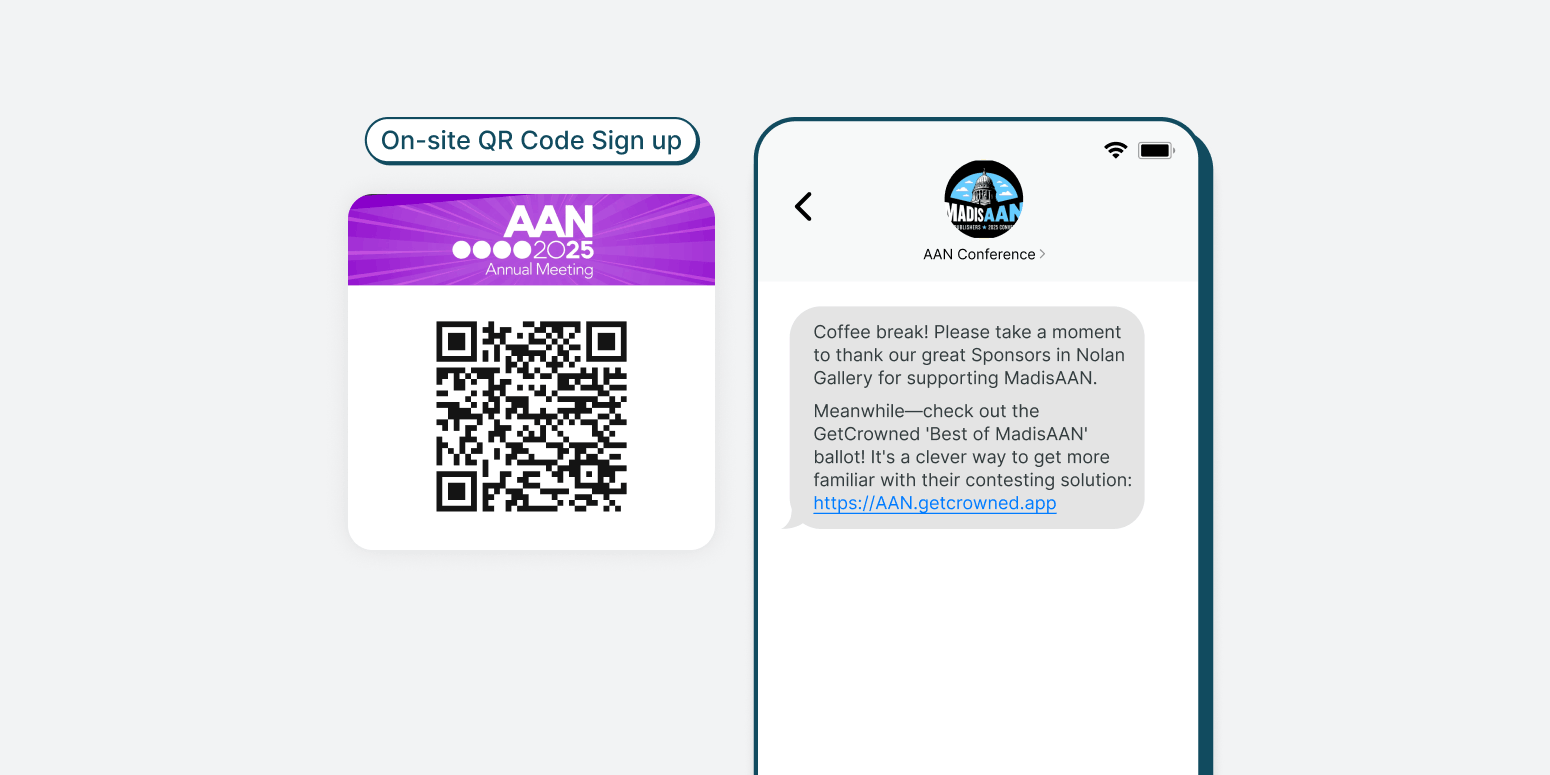
With Subtext, AAN promoted SMS sign-ups through its weekly newsletter, pre-event attendee communications, and an on-site QR code. Once attendees joined, organizers used the channel to send real-time updates, including reminders, schedule changes, evening event details, sponsor highlights, and weather-related announcements.
The campaign transformed AAN's audience data strategy, taking them from zero mobile audience data to collecting phone numbers from nearly 60% of conference attendees. By the end of the event, 83 attendees had opted into the Subtext campaign, creating a valuable first-party data asset. Despite sending 19 texts throughout the conference, AAN saw just a 1% churn rate.
The takeaway: when SMS helps attendees navigate the event, stay informed, and receive timely updates, it becomes more than a promotional channel. It becomes an owned audience channel that supports event operations, sponsor visibility, and long-term audience engagement.
How SMS and Email Work Together for Event Marketing
SMS and email are strongest when they play different roles.
Email is better for longer explanations, speaker details, full agendas, sponsor information, and post-event recaps. SMS is better for urgency, reminders, real-time updates, quick feedback, and direct action.
This distinction matters because audiences do not want every channel to do the same job. A long agenda may belong in email. A last-minute room change does not. A full recap may work best in email. A quick link to the recording may work better by text.
A strong event communication strategy might use both:
-
Invitations: Use email to provide the full event pitch and SMS to drive quick registration.
-
Reminders: Use email for detailed logistics and SMS for timely nudges.
-
Live updates: Use SMS for schedule changes, room updates, and key alerts.
-
Post-event follow-up: Use email for the full recap and SMS for surveys, recordings, or next-event links.
This combination gives audiences the information they need without forcing every message into one channel.
Subtext fits into that strategy by making SMS the direct, personal layer of event communication. Teams can use it to reach the right audience at the right moment, collect first-party feedback, and continue the relationship after the event ends.
Turn Event SMS Into an Ongoing Audience Relationship
The strongest SMS event strategies do more than promote a single registration page.
They help teams build a direct relationship with their audience before, during, and after the event. Pre-event messages drive awareness and attendance. Live updates improve the attendee experience. Post-event follow-ups collect feedback, extend the value of the event, and create a path to future engagement.
That matters because events are one of the clearest opportunities to turn audience attention into owned engagement. When someone registers, attends, replies, clicks, or shares feedback, they are giving the organization a signal about what they value. SMS helps teams capture and act on those signals in a direct, measurable way.
Subtext gives publishers, creators, brands, nonprofits, membership organizations, media teams, and event marketers the tools to manage that full event communication lifecycle in one place. With two-way messaging, audience groups, automation, analytics, integrations, and first-party audience data, teams can make every event message more timely, personal, and useful.
Ready to make SMS a stronger part of your event strategy? Book a Subtext demo or explore our FAQ to learn how direct audience messaging can support your next event.