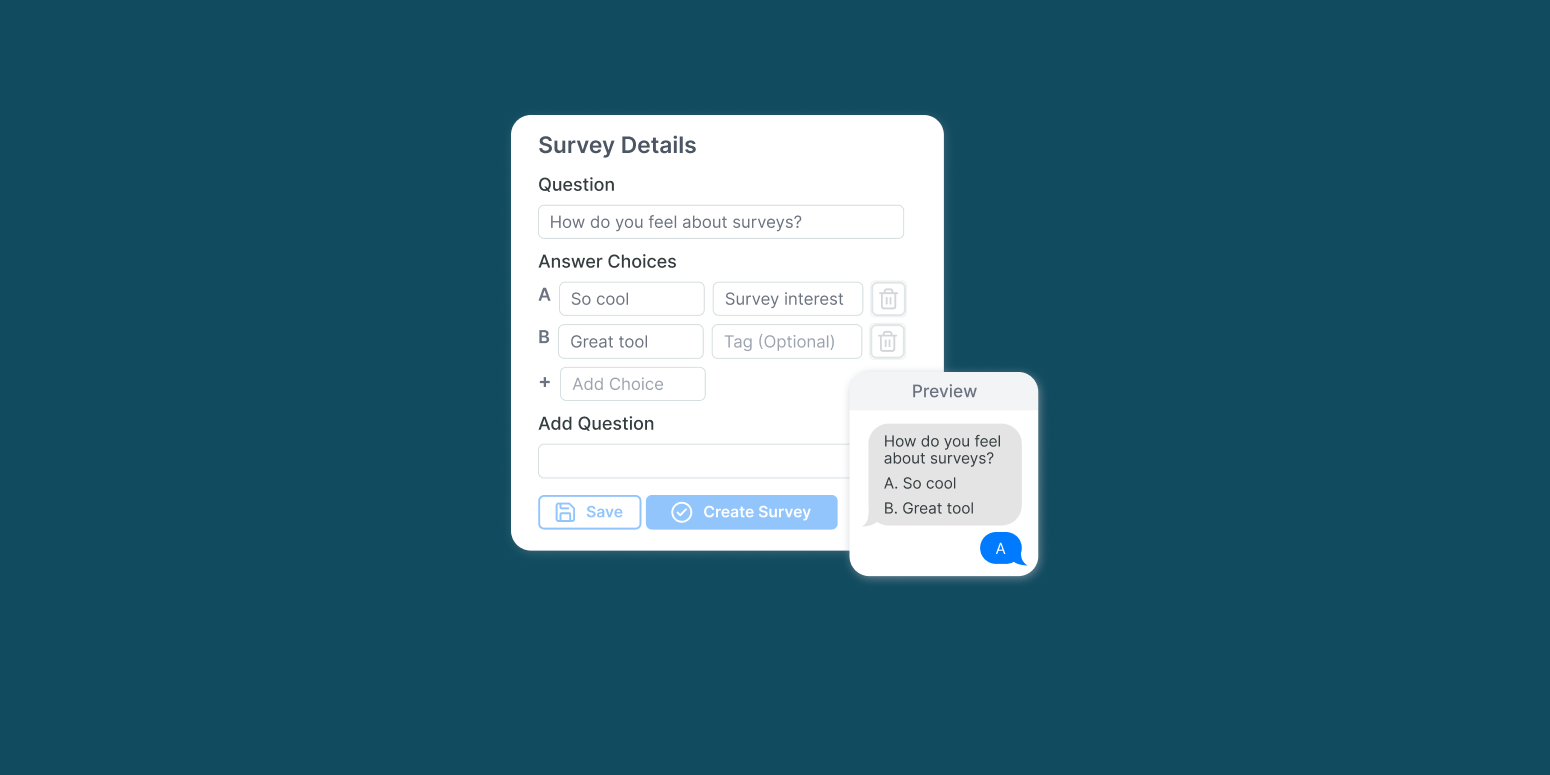
Designing SMS Surveys in 2026: Strategies for Maximum Responses
Published by Subtext on
Jun 24, 2026
SMS surveys can be one of the fastest ways to understand what your audience thinks, wants, and needs. But high completion rates do not happen just because a survey is sent by text.
They happen when the survey feels easy to answer.
That matters because SMS is a personal, high-attention channel. People are more likely to respond when the ask is clear, relevant, and respectful of their time. They are less likely to respond when a survey feels too long, too broad, or too disconnected from their actual relationship with your organization.
For publishers, creators, media companies, nonprofits, sports teams, event organizers, membership groups, and brands, well-designed SMS surveys can turn audience engagement into actionable first-party data. That feedback can help shape content, improve events, strengthen loyalty, identify high-intent audience segments, and inform revenue strategy.
Here’s how to design SMS surveys that get higher completion rates and better responses.
Key Takeaways
-
SMS surveys work best when they are short, focused, and easy to answer from a phone.
-
The highest-completion SMS surveys usually ask one clear question or a short sequence of two to three questions.
-
Closed-ended formats, such as yes/no, multiple choice, ratings, and short scales, reduce friction and make responses easier to analyze.
-
Conversational survey flows perform better than long forms because they feel more natural in a text message thread.
-
The best SMS survey strategy combines thoughtful question design, audience segmentation, timing, follow-up, and compliance.
-
Subtext helps teams collect structured feedback through direct, conversational SMS while keeping audience relationships personal and manageable.
Start With One Clear Survey Goal
A strong SMS survey starts with a specific objective. Before writing any questions, define what you need to learn and what you plan to do with the answers.
That step matters because SMS surveys work best when they are focused. If the goal is too broad, the survey usually becomes too long. And when a survey feels like work, completion rates drop.
A publisher might ask readers which local election issue they want more coverage on. A podcast might ask listeners what topic they want next. An event organizer might ask attendees how useful a session was. A nonprofit might ask supporters what kind of updates they want to receive. Each of those surveys has one clear job.
A good SMS survey objective should answer three questions:
-
What do we need to learn?
-
Who do we need to hear from?
-
What will we do with the responses?
Once the goal is clear, every question should connect directly to that outcome. If a question does not help you make a decision, improve an experience, or segment your audience more effectively, it probably does not belong in the survey.
For most SMS surveys, one to three questions is enough. Longer surveys can work, but they need a clear reason, strong audience relevance, and a conversational flow that keeps people engaged.
Keep SMS Surveys Short and Easy to Complete
The biggest mistake teams make with SMS surveys is trying to recreate a long web survey inside a text message.
SMS is not built for that.
Texting is fast, direct, and conversational. People expect to understand the ask immediately and respond with minimal effort. The more steps you add, the more likely people are to drop off.
A strong SMS survey should feel like a simple exchange, not an assignment.
Instead of asking:
“Please complete this five-minute survey about your experience with our recent event.”
Try:
“Quick question: How useful was today’s session? Reply 1–5, with 5 being very useful.”
The second version works better because it is specific, low-effort, and easy to answer from the message thread.
Short SMS surveys also make your data cleaner. When questions are simple and response options are clear, it is easier to analyze results, identify trends, and take action quickly.
Choose SMS-Friendly Question Formats
The best SMS survey questions are easy to answer with a short reply. Closed-ended formats usually perform best because they reduce friction and make responses easier to compare.
Common SMS survey formats include:
| Question Type | Best For | Example |
| Yes/no | Quick preference checks or simple qualification | “Would you attend another event like this? Reply YES or NO.” |
| Rating scale | Satisfaction, usefulness, or likelihood | “How helpful was this update? Reply 1–5.” |
| Multiple choice | Topic, format, or content preferences | “What should we cover next? Reply A, B, or C.” |
| NPS-style question | Loyalty or recommendation intent | “How likely are you to recommend us? Reply 0–10.” |
| Open-ended question | Qualitative feedback from engaged audiences | “What is one thing we could improve?” |
Open-ended questions can produce valuable insights, but they usually require more effort from the respondent. Use them carefully. They work best after someone has already engaged, such as after a rating question, event interaction, purchase, donation, subscription, or content experience.
For example:
“Thanks. What is the main reason for your score?”
That kind of follow-up can help explain the “why” behind the number without asking everyone to write a long response upfront.
Subtext makes this kind of structured feedback easier to manage because teams can collect replies directly through SMS instead of forcing audiences into disconnected forms or manual inbox workflows.
Make the Survey Feel Conversational
SMS surveys perform better when they feel like a natural text conversation.
That means sending one question at a time, using simple language, and avoiding dense blocks of copy. A conversational flow helps people stay engaged because each step feels manageable.
For example:
“Thanks for joining us today. Quick question: How useful was the session? Reply 1–5.”
Then, based on the response:
“Got it. What would make the next session more useful?”
This format feels more personal than sending a long link with several questions at once. It also gives your team more control over the experience because each response can trigger the next step.
Progress cues can help too, especially if the survey includes more than one question. A simple line like “Question 2 of 3” sets expectations and reduces drop-off because people know they are close to finishing.
A strong conversational SMS survey flow should:
-
Ask one question per message.
-
Use plain, direct language.
-
Avoid unnecessary context.
-
Tell people how to respond.
-
Let people know when they are done.
-
Thank respondents after completion.
-
The goal is to make participation feel effortless. The easier the survey feels, the more likely people are to finish it.
Segment Your Audience Before You Send
Relevance is one of the biggest drivers of SMS survey completion rates.
People are more likely to respond when the question clearly applies to them. That is why audience segmentation matters. Instead of sending the same survey to everyone, tailor the question based on the audience’s relationship, behavior, or interests.
A media company might survey sports subscribers about game-day coverage, while asking local news readers about election updates. An event organizer might survey attendees after a specific session. A nonprofit might ask recent donors about campaign messaging, while asking volunteers about event logistics.
This kind of targeting improves completion rates because the message feels more relevant. It also improves the quality of the data because responses come from the audience segment most connected to the question.
Useful SMS survey segments might include:
-
Recent attendees
-
Paid subscribers or members
-
Newsletter readers
-
Donors
-
Event registrants
-
Podcast listeners
-
Sports fans
-
Local audiences
-
VIP or high-engagement audience groups
-
Prior purchasers or customers
-
People who replied to a previous message
Subtext’s Audience Groups feature helps teams organize subscribers by behavior, interest, source, campaign, or engagement level. That makes it easier to send surveys to the right people instead of over-messaging the full list.
Write Neutral Questions That Do Not Lead the Audience
Good SMS survey design is not just about getting more responses. It is about getting useful responses.
Leading questions can inflate results, create false confidence, or make feedback less actionable. If the wording pushes people toward a certain answer, the data becomes less reliable.
Instead of:
“How much did you love our new member benefit?”
Use:
“How useful was the new member benefit? Reply 1–5.”
Instead of:
“Do you agree that our event was valuable?”
Use:
“Was the event valuable to you? Reply YES or NO.”
Neutral wording gives people permission to answer honestly. That is especially important for organizations using survey data to make decisions about content, programming, membership, events, products, or audience strategy.
SMS survey questions should be:
-
Clear
-
Specific
-
Neutral
-
Easy to answer
-
Focused on one idea at a time
A simple test: if someone could misunderstand the question or feel pushed toward one answer, rewrite it.
Time Surveys Around the Audience Experience
Timing has a major impact on SMS survey completion rates.
The best time to send a survey is usually when the experience is still fresh. For post-event feedback, that may be shortly after a session ends or the morning after the event. For content feedback, it may be soon after someone receives a story, episode, newsletter, or update. For support, membership, or customer experience surveys, it may be immediately after the interaction is complete.
The reason is simple: people respond better when they remember the experience clearly.
But timing also needs to respect the audience. Sending too late, too often, or at inconvenient hours can increase opt-outs and weaken trust.
A strong SMS survey timing strategy should consider:
-
When the experience happened
-
When the audience is most likely to be available
-
Whether the question is urgent or reflective
-
How often that audience segment has already been messaged
-
Whether the message falls within appropriate sending hours
For recurring surveys, teams should also watch response trends over time. If completion rates drop, it may be a sign that the survey is too frequent, too broad, or not valuable enough to the audience.
Subtext’s reporting helps teams monitor engagement patterns, response rates, click-through rates, and opt-outs so they can refine timing instead of relying on guesswork.
Use Reminders Carefully
A reminder can improve completion rates, but only when it feels helpful rather than pushy.
For SMS surveys, one reminder is usually enough. The reminder should be short, friendly, and clear about why the feedback matters.
For example:
“Reminder: We’d still love your feedback on yesterday’s event. One quick question: How useful was it? Reply 1–5.”
The key is to keep the reminder proportional to the ask. If the survey is simple and relevant, a reminder can work well. If the survey is long or unclear, a reminder may only increase frustration.
Avoid sending repeated reminders to people who have already ignored the survey. That can create fatigue, especially in a personal channel like SMS.
A better approach is to use engagement data to refine who receives follow-ups. For example, you might remind people who clicked but did not finish, or people who attended an event but did not answer the first message.
Subtext helps teams manage follow-up workflows without turning SMS into a blunt broadcast tool. That matters because effective survey strategy depends on maintaining trust, not just increasing response volume.
Connect Survey Responses to Action
SMS survey data is most valuable when it does more than sit in a spreadsheet.
The purpose of collecting audience feedback is to make better decisions. That might mean refining editorial coverage, improving an event, identifying high-intent subscribers, shaping a membership offer, informing sponsor packages, or personalizing future messages.
For example:
-
A newsroom can use survey replies to identify which beats audiences want more coverage on.
-
A podcast can use listener responses to plan future episode topics.
-
A sports organization can use fan feedback to improve game-day communication.
-
A nonprofit can use donor preferences to tailor fundraising updates.
-
An event team can use attendee feedback to improve programming and follow-up.
-
A creator can use audience responses to decide what content, merch, or paid offering to launch next.
This is where SMS becomes more than a feedback channel. It becomes a way to build first-party audience intelligence.
Subtext’s integrations and SMS API help teams connect SMS survey responses to existing systems, including CRMs, analytics tools, support workflows, and internal reporting. That makes feedback easier to act on and easier to connect to broader audience strategy.
Protect Trust With Consent, Privacy, and Clear Opt-Outs
High completion rates should never come at the expense of audience trust.
SMS is a permission-based channel. People need to know what they signed up for, why they are receiving a message, and how to opt out. Clear consent and transparent communication protect both the organization and the audience relationship.
SMS survey programs should follow a few core principles:
-
Only message people who have opted in.
-
Make the survey purpose clear.
-
Respect local sending rules and quiet hours.
-
Include opt-out language where appropriate.
-
Avoid collecting sensitive information unless it is necessary and properly handled.
-
Store and route survey data responsibly.
-
Review compliance requirements regularly.
-
In the U.S., the Telephone Consumer Protection Act, commonly known as TCPA, governs text-based outreach and requires proper consent for SMS communications. Other privacy and messaging rules may apply depending on region, audience, and use case.
Subtext supports responsible SMS engagement with opt-in and opt-out workflows, compliance-conscious tooling, reliable delivery practices, and customer support expertise. That gives teams a stronger foundation for collecting feedback without putting the audience relationship at risk.
Example SMS Survey Templates
Here are a few SMS survey examples that are short, clear, and easy to answer.
Post-event feedback
“Thanks for joining us today. Quick question: How useful was the session? Reply 1–5, with 5 being very useful.”
Follow-up:
“Thanks. What’s one thing we could improve next time?”
Content preference survey
“We’re planning next week’s coverage. What topic do you want more of? Reply A for local politics, B for events, or C for restaurants.”
Audience interest survey
“Quick check: Would you be interested in getting weekly texts about upcoming local events? Reply YES or NO.”
Member feedback survey
“Thanks for being a member. Which benefit do you value most? Reply A for exclusive content, B for events, C for discounts, or D for community access.”
Podcast listener survey
“We’re planning upcoming episodes. What should we cover next? Reply A for interviews, B for industry news, or C for listener questions.”
Donor or supporter survey
“What type of updates would you like most? Reply A for impact stories, B for campaign updates, or C for volunteer opportunities.”
Each example works because it asks one question, gives clear response options, and connects to a specific audience relationship.
Common SMS Survey Mistakes to Avoid
Even small design choices can hurt completion rates. Before sending an SMS survey, review it for common issues.
Avoid these mistakes:
-
Asking too many questions at once.
-
Using vague wording.
-
Sending the same survey to every audience segment.
-
Making people click a long form when a simple reply would work.
-
Asking open-ended questions too early.
-
Sending surveys too often.
-
Failing to explain why the feedback matters.
-
Ignoring opt-outs or compliance requirements.
-
Collecting responses without a plan to use them.
-
The best SMS surveys respect the audience’s time. They make the question easy to answer and make the response worth collecting.
How Subtext Helps Teams Run Better SMS Surveys
Subtext helps organizations turn SMS surveys into direct, conversational audience engagement.
Instead of treating surveys as one-off forms, teams can use Subtext to ask timely questions, collect replies, segment audiences, trigger follow-ups, and connect response data to broader workflows.
With Subtext, teams can:
-
Send conversational SMS surveys to targeted audience groups.
-
Collect first-party feedback directly through text replies.
-
Use keywords, polls, reply triggers, and message sequencing to structure survey flows.
-
Track engagement, response rates, click-through rates, and opt-outs.
-
Use audience responses to inform segmentation and future messaging.
-
Connect SMS feedback to internal systems through integrations and the Subtext API.
-
Get strategic support from a team with deep SMS, compliance, and audience engagement experience.
That combination matters because high-performing SMS surveys are not just about sending questions. They are about asking the right people the right questions at the right moment, then using those answers to build stronger audience relationships.
Build SMS Surveys People Actually Want to Answer
The best SMS surveys are short, relevant, and easy to complete. They respect the personal nature of texting while giving organizations a direct way to learn from their audience.
To improve SMS survey completion rates, start with one clear goal. Keep the question set focused. Use simple response formats. Segment the audience. Time the message thoughtfully. Follow up carefully. And make sure every response has a clear path to action.
For organizations that depend on audience relationships, SMS surveys can do more than collect feedback. They can reveal what your audience values, where engagement is strongest, and how to build more relevant experiences over time.
Subtext helps teams make that process easier by combining conversational messaging, audience segmentation, automation, analytics, integrations, and expert support in one SMS platform.
To learn how Subtext can help your team collect better audience feedback through SMS, book a demo or explore Subtext’s SMS FAQ.
Frequently Asked Questions
What is the ideal number of questions for an SMS survey?
Most SMS surveys should include one to three questions. Short surveys are easier to complete and usually produce cleaner, more actionable data. Longer surveys can work when the audience is highly engaged, but they should still be broken into a simple conversational flow.
How do you write SMS survey questions that get more responses?
Use clear, neutral wording and ask one question at a time. The question should be easy to understand, easy to answer, and directly connected to the audience’s recent experience or relationship with your organization.
What types of questions work best for SMS surveys?
Yes/no questions, rating scales, multiple-choice questions, and short NPS-style questions work well because they require minimal effort. Open-ended questions can be useful for deeper feedback, but they should be used sparingly.
When is the best time to send an SMS survey?
The best time depends on the use case, but surveys usually perform well when sent soon after the relevant experience. For example, event surveys should be sent while the event is still fresh, while content feedback should be requested shortly after the audience engages with the content.
How can teams avoid SMS survey fatigue?
Send surveys only when the feedback has a clear purpose. Segment audiences so people receive relevant questions, limit reminders, avoid over-surveying, and pay attention to opt-out and response trends.
What metrics should teams track for SMS survey performance?
Track completion rate, response rate, opt-outs, click-through rate if links are used, and qualitative trends in replies. Teams should also track how survey responses influence future messaging, segmentation, content, events, or revenue strategy.