
For a long time, SMS has been framed as a campaign channel.
You launch a promotion. You blast a message. You measure clicks. You move on.
Serious teams don’t think about Subtext that way.
They treat it as owned audience infrastructure — a durable system that sits alongside their CRM and data stack, compounding value over time instead of resetting every campaign.
This distinction matters more than ever as acquisition costs rise, platforms become less reliable, and audience relationships become the real moat.
Campaign Tools Are Temporary. Infrastructure Compounds.
Campaign tools are designed for moments.
Infrastructure is designed for years.
Early on, it’s natural for teams to evaluate Subtext the same way they evaluate other messaging tools:
-
How many clicks did this send get?
-
What was the opt-out rate?
-
Did this message convert?
Those questions aren’t wrong; they’re just focused on a single moment. Teams that treat Subtext as infrastructure eventually ask a different set of questions, oriented around growth, identity, and long-term value:
-
How does this grow our owned audience over time?
-
How does this data feed the rest of our stack?
-
How does each interaction make the next interaction more valuable?
The power isn’t in a single send. It’s in what accumulates when every interaction deepens identity, context, and trust.
Where Subtext Fits in a Modern Stack
Serious teams don’t replace their stack with Subtext. They integrate it.
In practice, Subtext sits alongside core systems like CRM and data infrastructure and handles a job those tools don’t: capturing permissioned audience identity and enabling direct, two-way engagement at scale.
Subtext operates downstream from content distribution and upstream from monetization. It’s where anonymous attention becomes a known subscriber, where engagement history accumulates, and where teams can trigger, personalize, and automate communication based on real audience behavior, not assumptions.
Over time, this creates a durable source of truth for audience relationships that feeds the rest of the stack instead of living in isolation.
Subtext as the Activation Layer for Content
Content creates attention. Subtext activates it.
Instead of content being a one-way broadcast, Subtext allows teams to:
-
Reach audiences at the moment when intent is highest
-
Segment subscribers based on what they engage with and respond to
-
Extend articles, shows, drops, and posts into ongoing conversations
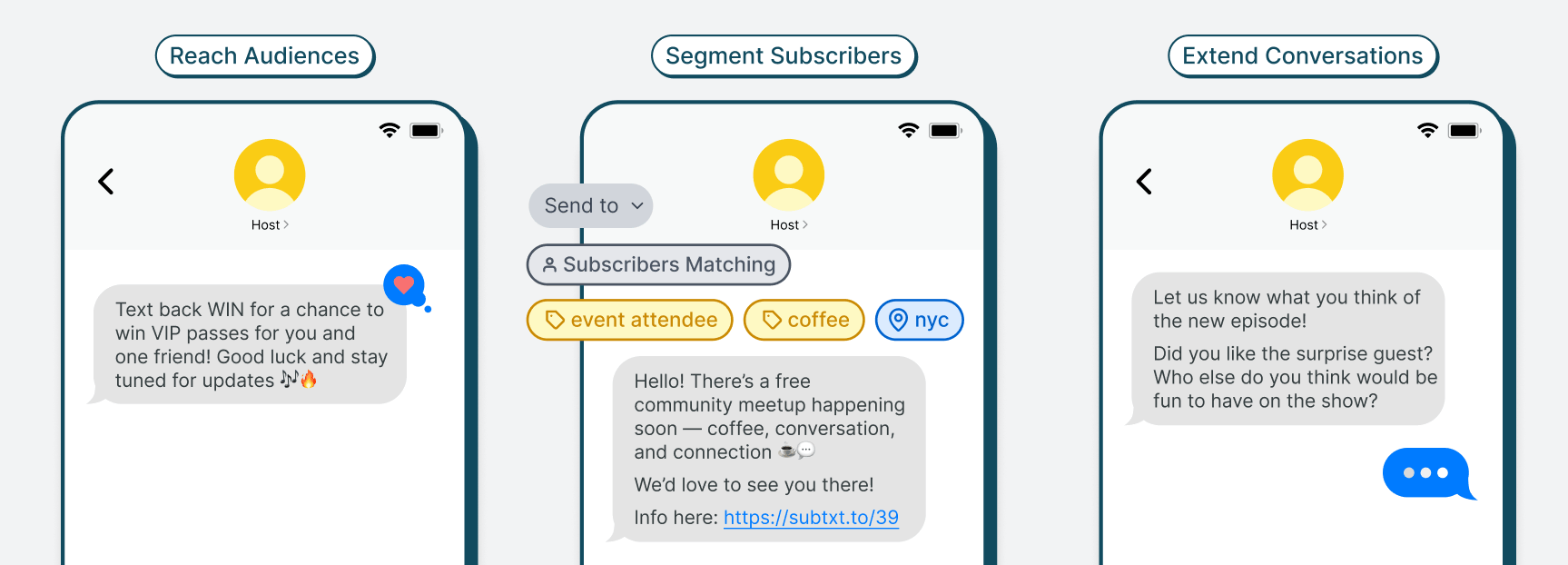
Direct messaging changes the lifecycle of content — turning a single publish moment into a series of relationship‑building touchpoints. Subtext becomes the system that keeps content working after it leaves the feed or inbox.
Subtext + CRM: Turning Audience Relationships into Usable Systems
CRMs are excellent at managing customers — but they’re rarely designed to capture audience relationships before a transaction happens.
Subtext fills that gap.
When integrated with a CRM, Subtext gives teams a way to:
-
Capture permissioned, phone-number-level identity before someone ever becomes a lead or customer
-
Maintain a continuous engagement record that reflects conversations, preferences, and responsiveness, not just purchases
-
Promote audience members into CRM workflows at the right moment, with real context attached
SMS opt-ins aren’t just another field in a database. They represent explicit consent and a direct line of communication. Over time, this turns the CRM from a static record of transactions into a system informed by real audience behavior without relying on cookies, third-party platforms, or guesswork.
Subtext + Data Infrastructure: Making Audience Behavior Actionable
This is where Subtext most clearly behaves like infrastructure.
When Subtext connects to analytics tools and internal systems, it becomes part of a feedback loop rather than a broadcast channel.
Teams can:
-
Trigger messages based on real-world events and audience actions, not predefined schedules
-
Continuously update segments as behavior changes, instead of rebuilding lists manually
-
Feed response data back into analytics and internal systems to inform content, product, and monetization decisions
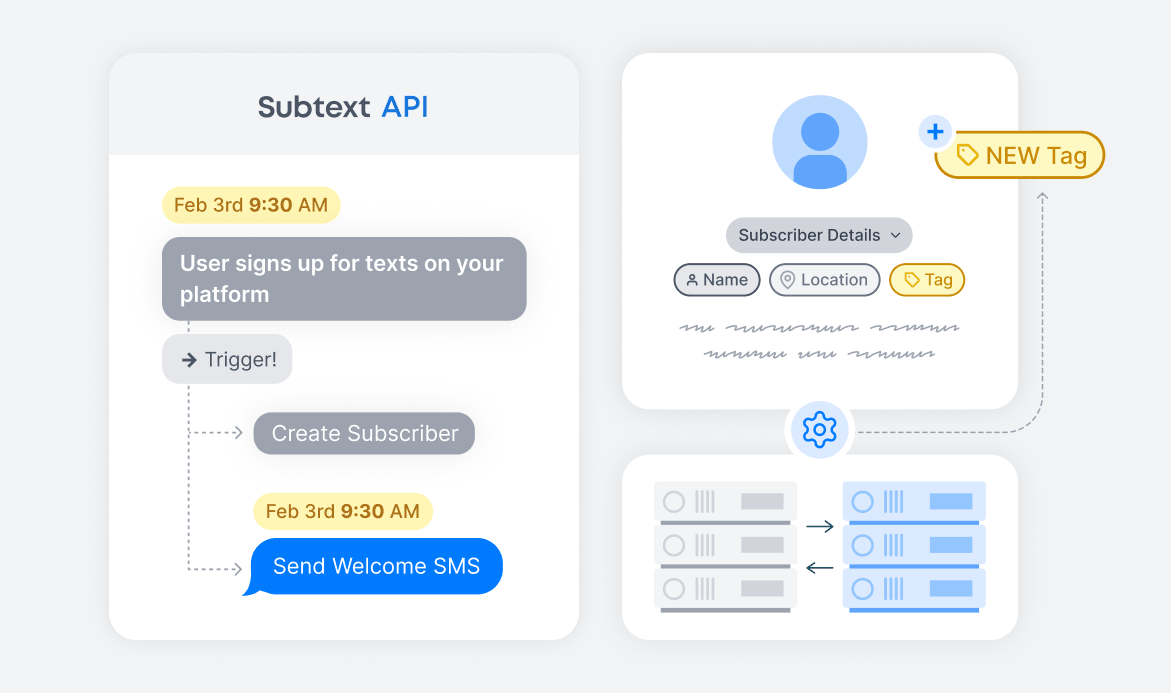
This shifts Subtext from a tool teams use occasionally to a system that responds in real time. Messaging becomes adaptive, shaped by audience signals, rather than something teams manually push out and hope performs.
Why Infrastructure Compounds Value Over Time
Campaign tools reset to zero every time you launch something new. Infrastructure never does. Here’s what compounds when Subtext is treated as a system, not a tactic:
Identity
Every opt-in strengthens your owned identity layer.
Context
Every reply adds nuance about preferences, timing, and intent.
Trust
Every relevant message increases the likelihood that the next one will be welcomed.
Efficiency
Every integration reduces manual work and improves targeting.
Over months and years, this creates something competitors can’t copy: a deeply connected, permissioned audience that responds because they want to, not because an algorithm decided to show them something.
Audiences aren’t built in bursts. They’re built through consistency, respect, and systems that make personalization scalable.
What Serious Teams Build Instead of “SMS Campaigns”
They build:
-
Always-on audience channels, not seasonal blasts
-
Systems that talk to each other, not siloed tools
-
Long-term audience equity, not short-term metrics
Subtext isn’t just another place to send messages. It’s the infrastructure that lets teams own their audience relationships end-to-end, across content, data, and time. Once you start thinking about it that way, “SMS campaigns” feel like the smallest possible use case.
Ready to Build Owned Audience Infrastructure?
If you’re still thinking about SMS as a campaign channel, you’re leaving long-term value on the table. Subtext is built for teams that want to:
-
Own their audience relationships end-to-end
-
Activate audiences intelligently across content, data, and systems
-
Build infrastructure that compounds over time — not tools that reset every send
If that sounds like you:
-
Book a demo to see how serious teams use Subtext as their activation and identity layer
-
Or explore our FAQ to dig deeper into how Subtext works, integrates, and scales
However you start, the goal is the same: stop renting attention — and start building something you actually own.